Scheduled releases—such as inflation data (like CPI), jobs data, or central-bank decisions—arrive at a published, known time, so the market knows when uncertainty resolves. Ahead of the release, the visible book thins and spreads widen. At the print, volume and speed jump. The first move can be fast, partial, and reversed within seconds as orders fill at poor prices and algorithms react to headlines. Reading order flow requires separating resting from executed liquidity, recognizing why the earliest print misleads, and waiting for the market to digest before assessing acceptance.
The visible book ahead of the release
Only aggressive orders move the market. Passive limit orders sit as barriers: bids below, asks above. For price to tick higher, aggressive buying must consume the passive ask. Market buys pair with waiting asks; market sells with waiting bids (Bid/Ask Volume and Aggressors).
Ahead of the release, liquidity providers commonly quote smaller size and wider spreads, leaving the visible book thinner; resting orders can be cancelled right before or at the print. Book depth changes within seconds (375 contracts -> 100 in two seconds). Do not trust what sits in the book—trust what actually trades. The book is what is offered (can be pulled at any time); the footprint is what happened (cannot be retracted).
Why the first seconds mislead
At the release, volume and speed jump, and spreads widen. The initial move is often fast, partial, and reversed within seconds as orders fill at poor prices and algorithms react to headlines. Orders in the first seconds can fill far from the expected price (slippage).
Because the book is thin, price traverses levels on low volume. An extreme created by a news spike does not carry normal auction logic (Reading Big Trades). Mistaking the opening seconds for a verdict confuses execution noise with conviction. After the first seconds, the market usually spends time digesting; participants reassess, and acceptance or rejection becomes visible only after some time.
Footprint imbalances and delta in the news window
An imbalance reflects pronounced dominance of one aggressive side read diagonally (aggressive buys at price P versus aggressive sells at P-1). In a news spike, standard interpretations fail:
- Imbalance requires real volume: A 6:2 cell is technically 300 %, but two contracts are noise. In a hollow book, spikes print high ratios on negligible volume. Scale volume to the market normal (Footprint Imbalance and Absorption Guide).
- Bar delta context: Measures aggressive buys minus sells in one bar. A large delta on a spike often reflects swept liquidity rather than continuation. A +20 delta on 30 contracts is noise; delta in thin sessions versus after the US open are different worlds (Bar Delta Basics).
- Cumulative Delta (CVD): Delta describes now; CVD tracks the running sum of bar deltas to reveal who wins over time.
| Metric | Normal Session | News Window |
|---|---|---|
| Visible Book | Denser resting limit orders. | Commonly thinned; quotes shrink, orders cancel. |
| First Move | Continuous two-way auction. | Fast, partial, often reversed; slippage. |
| Imbalance | Directional aggression with volume. | Distorted by empty levels; scale to normal. |
| Absorption | Passive defense at marked levels. | False wicks from wide spreads; needs 3 conditions. |
Absorption and unfinished auctions
News reactions produce violent wicks, easily mistaken for absorption. Absorption appears on almost every candle—by itself it is not a signal; trading every absorption leads to overtrading. Real absorption requires three conditions together:
- Size: Volume at the extreme well above the candle's per-level average.
- Cross ratio: The failing aggressor diagonally dominates the other side.
- Rejection: The close genuinely backed away from the extreme (a real wick).
Absorption is never traded on its own, only in confluence with a key level.
An unfinished auction occurs when trades print on both bid and ask at the candle's absolute high or low. The market tends to return and complete it; on its own, not a signal.
A practical literacy checklist
Observe the structural sequence:
- Before the release: Check visible book depth. Note whether spreads widen and quoted size shrinks. Resting orders can pull at any time.
- During the initial seconds: Acknowledge jumps in volume and speed. Spreads widen and slippage increases; the first print is often noise rather than a confirmed move.
- After the market digests: Look for evidence of acceptance (price trading and holding at a new area) versus rejection (heavy volume absorbing advances and price backing away).
Studying the reaction with Anchored Volume Profile
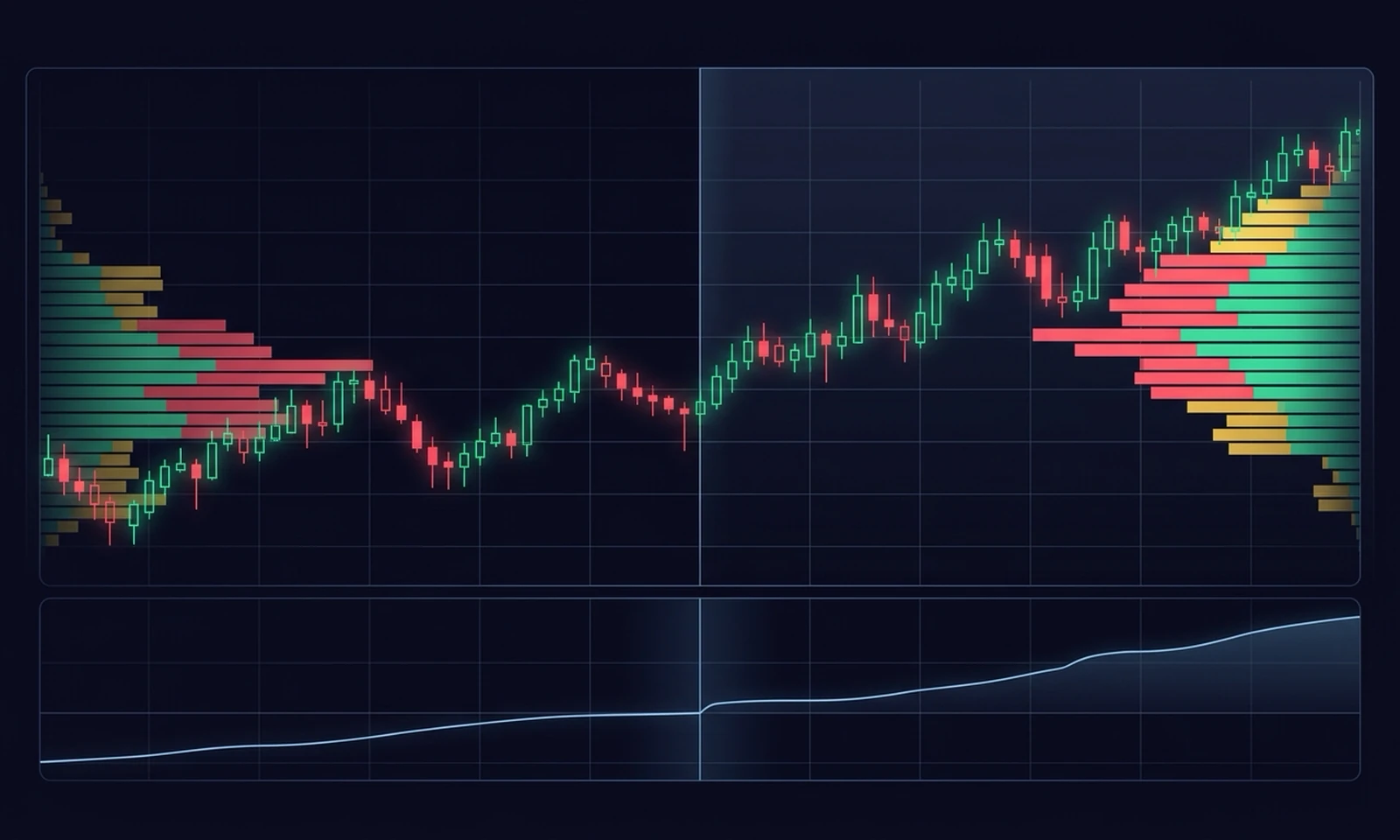
Once initial volatility subsides, evaluate the response using Anchored Volume Profile. Select a range such as the reaction to a major news release and plot volume distribution for it.
Anchor to a logical starting point—such as the news event or a sharp impulsive move. Random anchoring gives random results. Check whether volume keeps being added to the move or dries up. Anchored Volume Profile provides structural perspective on participation, but it does not predict where price will go.
Honest limits: slippage, spreads, and invalidation
Reading order flow requires accepting structural limits. Around news, wide bid/ask spreads and slippage mean executions occur far from intended levels. Even after waiting for digestion, an interpretation of acceptance can be wrong.
An honest note on risk: Macroeconomic releases, central-bank decisions, and expiry events can overrun technical levels and order-flow structures. Order-flow tools and dealer hedging models describe mechanics, not guarantees. Slippage can be severe. Trading carries risk of loss; nothing here is a recommendation.
Frequently asked questions
Why does the visible order book thin ahead of scheduled news?
Liquidity providers commonly quote smaller size and wider spreads ahead of the release, leaving the visible book thinner; resting orders can be cancelled right before or at the print.
Why does the first print after a news release often mislead?
Volume and speed jump while the book is thin, producing fast, partial moves and slippage as algorithms react to headlines before participants digest the release.
How should footprint imbalances be read around news?
Imbalances require real volume. In an empty book, a 6:2 cell shows a 300 % ratio but is noise. Always scale volume against what is normal for that market and time of day.
Does Anchored Volume Profile predict post-news direction?
No. Anchored Volume Profile shows how volume was distributed across the reaction to reveal participation, but it does not predict where price will go.
The Volume Imprint study ($17/mo paid) visualizes diagonal imbalances, three-condition absorption, and unfinished auctions, while Delta Volume ($9/mo paid) tracks per-bar delta; CVD and Bid/Ask are free forever, with a 14-day free trial on all studies. Related reading: Bid/Ask Volume, Footprint Guide, Bar Delta, and Anchored Volume Profile.