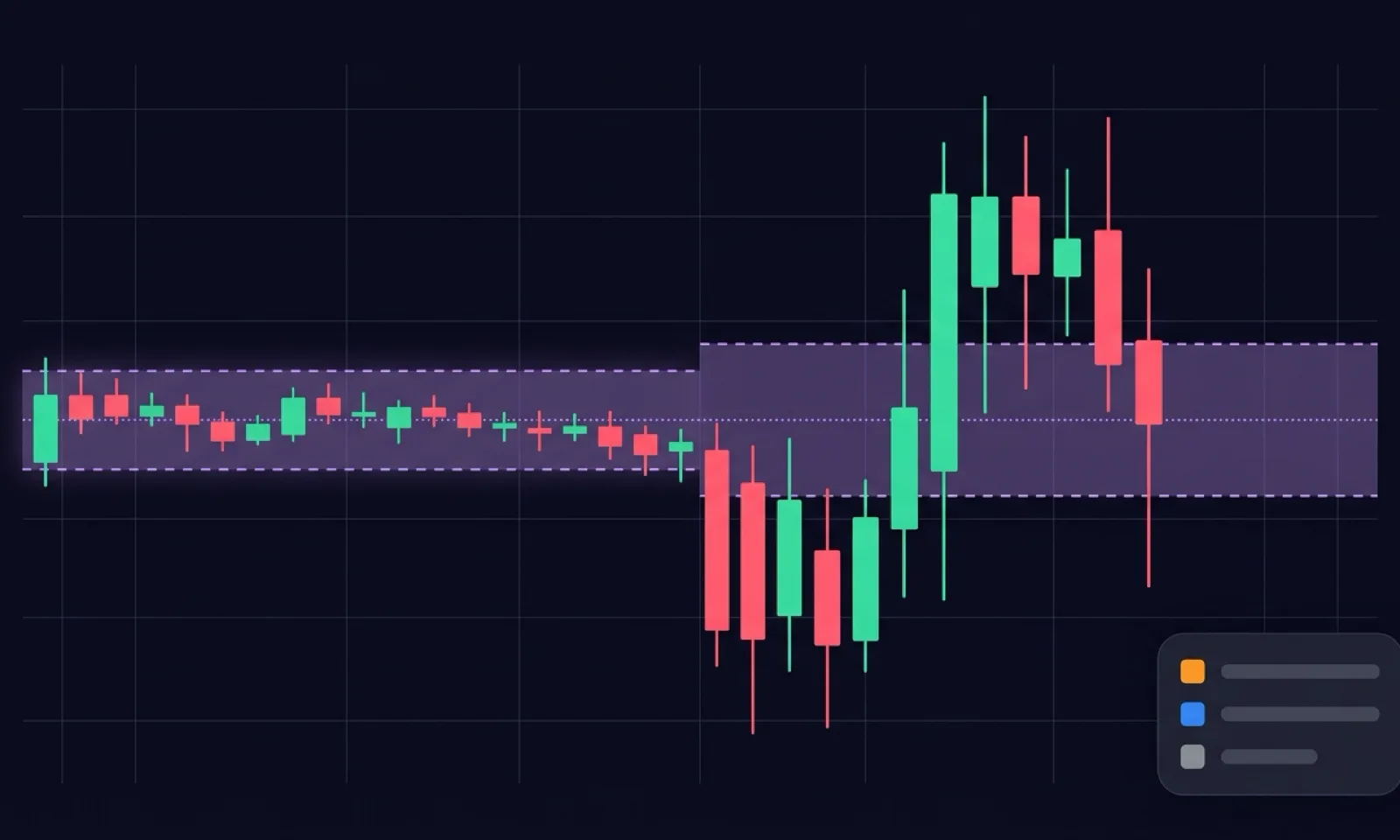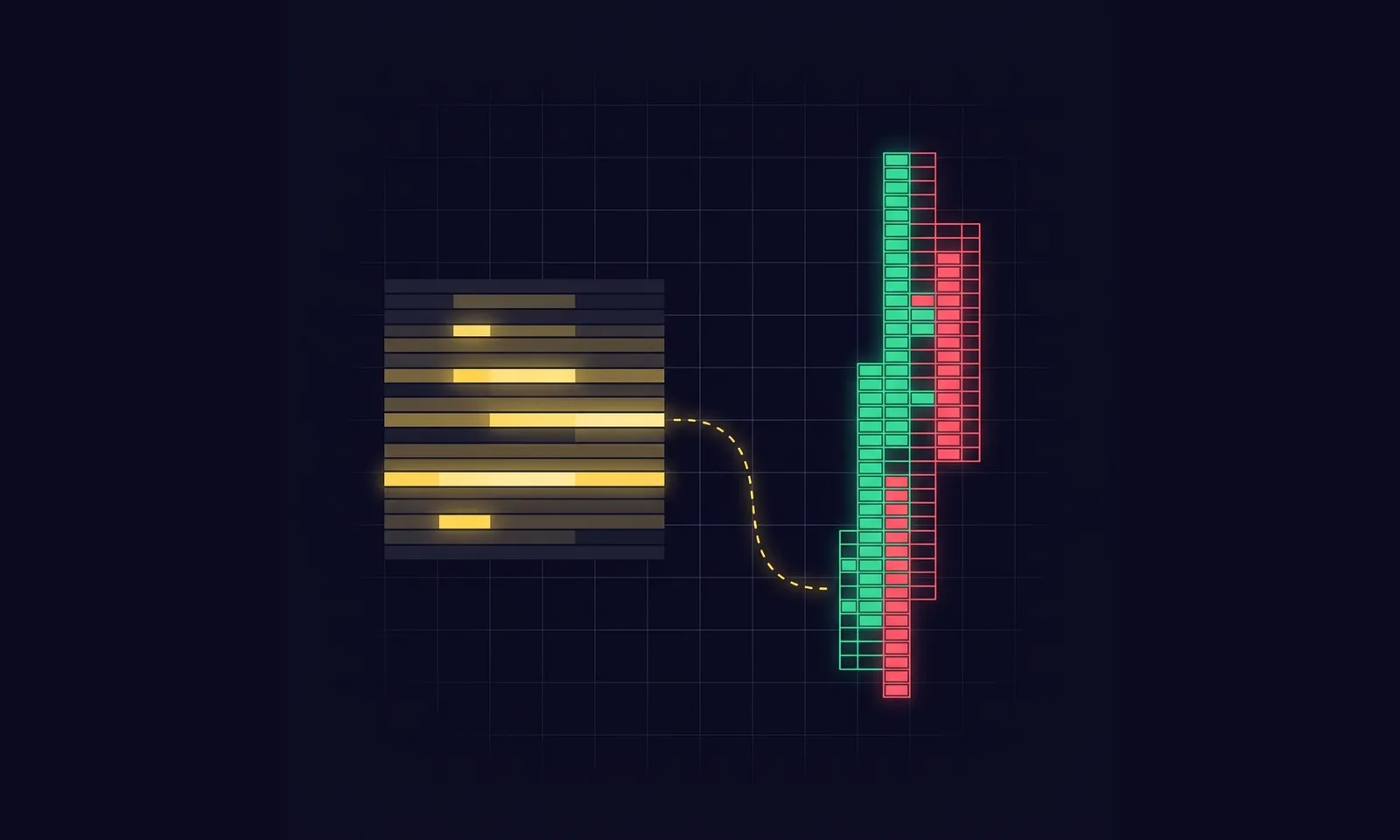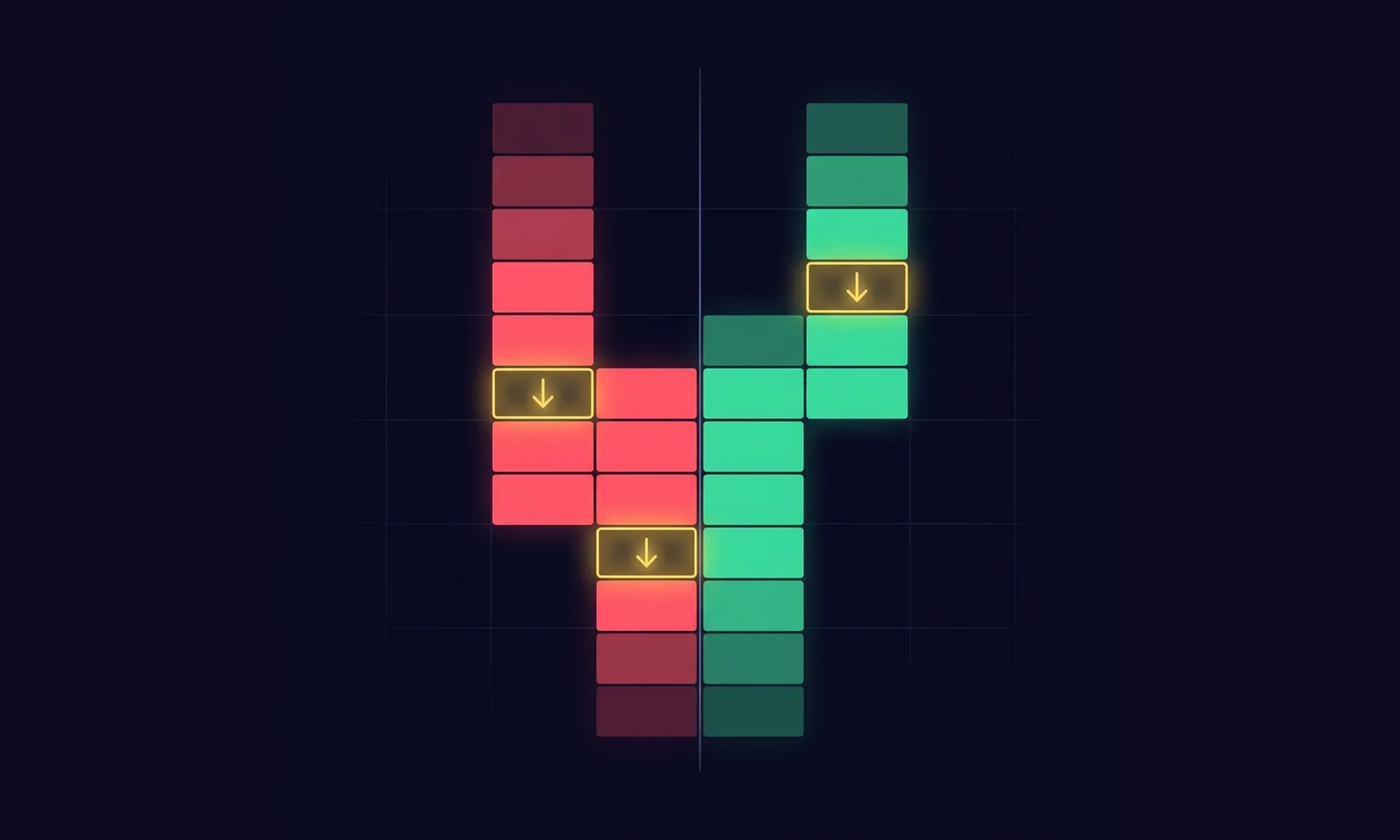
A single diagonal imbalance says someone was aggressive at one tick. A stacked imbalance says that aggression walked through several consecutive prices without the other side answering. That difference — one cell versus a run of cells — is the gap between noise and structure.
This article is a deep dive on stacks. For the foundation (what a diagonal imbalance is, the three conditions of real absorption, unfinished auctions), start with Footprint: Imbalance, Absorption and Unfinished Auctions. Here we stay on consecutive aggression: when three or more levels matter, how to stop treating every 300% print as news, and how confluence turns a stack into a future support or resistance zone.
Diagonal first — then consecutive
An imbalance is read diagonally: aggressive buys at price P against aggressive sells at P−1 (or the mirror for selling). Side-by-side reading compares two different auctions; diagonal reading compares the forces actually fighting each other. The usual threshold is roughly 300% (one side ≥ 3× the other). WyckFlow’s Volume Imprint can flag these with a volume gate so tiny ratios do not light up the chart.
A stacked imbalance is simply that pattern repeating on consecutive levels, same side, inside the same bar (sometimes bridging a short sequence of bars at the same zone). Three consecutive buy imbalances climbing through offers is not “three coincidences” — it is a short auction where buyers kept paying up and sellers failed to refill.
Why three or more levels change the story
One 300% cell can be a single clip, a thin book, or a one-tick quirk. Three or more consecutive cells in the same direction usually means willingness to accept slippage, failure of the other side to refill, and a price band — not a single tick — that later retests may respect.
Two levels is a grey area. The practical literacy rule is three consecutive as the minimum for “stack,” with absolute volume still required.
Filtering 300% noise
Percentage without size is decoration. Treat every flagged imbalance as a candidate until it passes a volume filter scaled to the instrument and session:
| Filter | What to ask | Why it matters |
|---|---|---|
| Absolute volume | Are the contracts at those levels above this market’s normal per-tick print? | A 6:2 cell is 300% and still noise. |
| Session context | Asian thin tape vs US cash open? | The same ratio means different things. |
| Continuity | Same side on consecutive levels, not alternating flicker? | Alternation is chop, not a stack. |
| Location | At a prior high/low, VWAP, profile edge, or GEX wall — or in the middle of nowhere? | Structure without location is a souvenir. |
A mid-range stack on low volume is trivia; the same stack into yesterday’s high, a Value Area edge, or a Call/Put Wall is a hypothesis worth watching on the retest.
Stacked imbalance as structure (not a trade)
The stack marks where aggressive inventory was built. Players who paid through several ticks often defend that band later — as support (buy stacks) or resistance (sell stacks) — when the rest of the tape agrees. It is not a guaranteed bounce, not permission to fade the creating move, and not a substitute for reading the retest.
On the retest, look for confirmation you already trust: delta flipping with the defense, CVD stopping extremes, absorption at the stack edge, or resting liquidity holding on the heatmap. No confluence — no trade idea.
Stack vs single imbalance vs absorption
Keep the vocabulary clean:
- Single imbalance — one diagonal cell above threshold. Common. Usually needs volume + location to matter.
- Stacked imbalance — consecutive same-side imbalances. Marks a band of conviction; best as future S/R structure.
- Absorption — large volume at an extreme where price fails to continue (three conditions: size, diagonal dominance of the failing side, rejection wick). Absorption is about failure to progress; a stack is about progress with conviction. They can appear near each other, but they answer different questions.
If you only remember one distinction: a stack that succeeds in moving price builds structure in the direction of the aggression; absorption that stops price builds structure against the aggression.
Practical reading checklist
- Spot a candidate stack (3+ consecutive, same side) with real absolute volume.
- Map it to a pre-existing level (session extreme, profile edge, VWAP, gamma wall).
- Wait for a later interaction — do not chase the printing bar unless a planned breakout already had other confirmation.
- On retest, require a second piece of evidence (delta, CVD, absorption, book) or invalidate if price slices through with no defense.
Common mistakes
- Trading every 300% cell. Filter, then wait for location.
- Counting two levels as a stack. Prefer three consecutive unless absolute size is exceptional.
- Ignoring which side built the stack. A buy stack below price is potential support — not a short magnet.
- Confusing stack with sweep. Sweeps leave thin/zero prints; stacks leave heavy one-sided prints (institutional patterns).
- Standalone entries. Structure first, timing second.
An honest note: stacked imbalances describe where aggression concentrated. They do not predict the next tick. Markets retest and fail. Risk, position size, and the decision remain yours — literacy is not a signal service.
Frequently asked questions
What is a stacked imbalance?
Three or more consecutive price levels in the same bar (or tight zone) showing diagonal imbalance in the same direction — typically at a 300%+ ratio with meaningful absolute volume. It marks a band of one-sided aggression, not a single noisy cell.
When do three or more levels matter?
When the stack carries real volume, stays on one side without flickering, and forms at a level the market already cares about. Mid-range stacks on thin tape rarely become structure.
How is a stack different from a single 300% imbalance?
A single imbalance is common and often noise. A volume-filtered stack occupies a price band and is more likely to be defended later — still only as confluence, never alone.
Should I enter when the stack prints?
Usually no. Use the printing bar as information that structure is forming. Timing belongs on the retest or on a planned breakout that already had other confirmation (delta, CVD, level).
Which study shows stacked imbalances?
Volume Imprint (footprint) flags diagonal imbalances with volume filters; stacks are consecutive same-side flags. Pair with CVD and Delta for timing context.
Deep dive companion to Footprint: Imbalance & Absorption. Related: Institutional activity on footprints, Bar Delta, CVD.