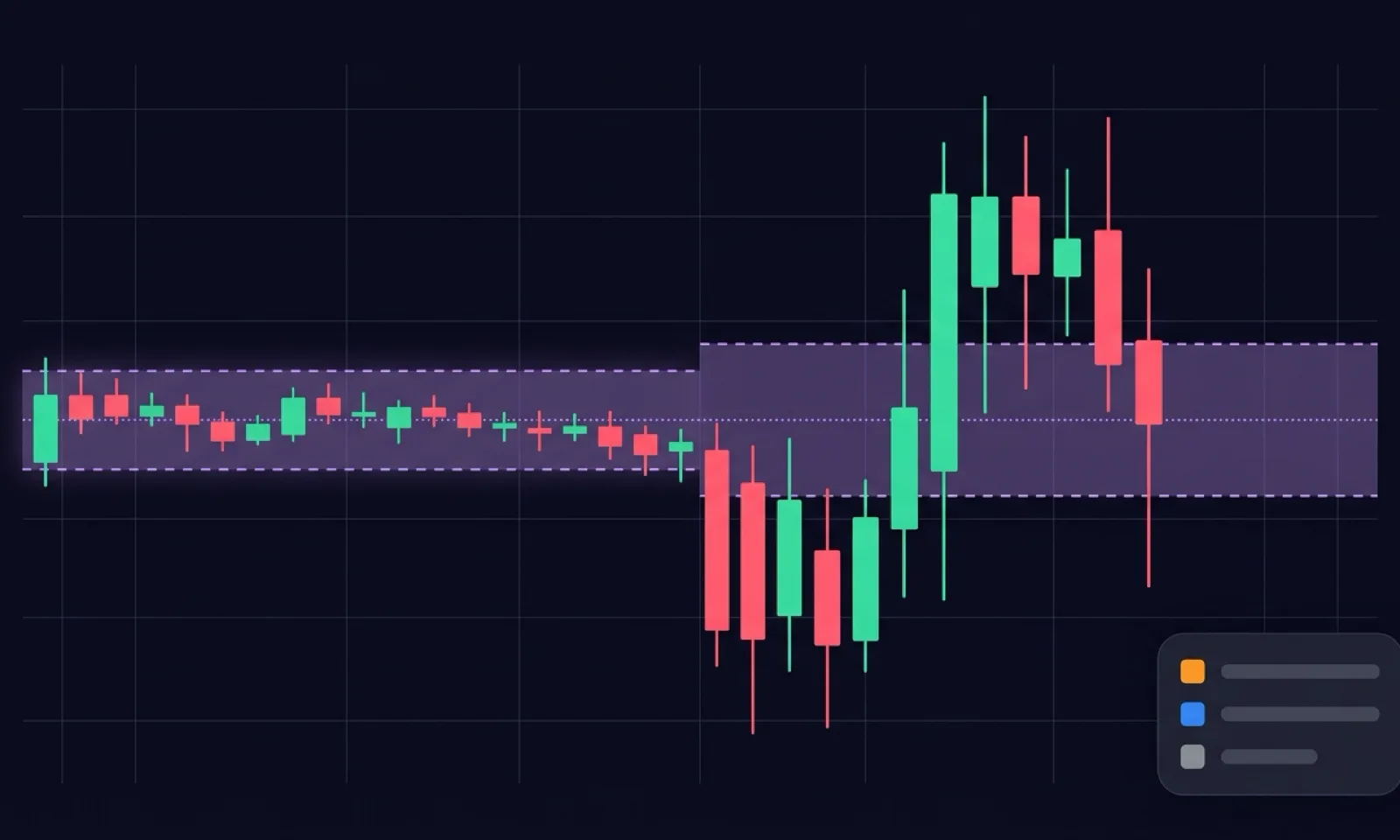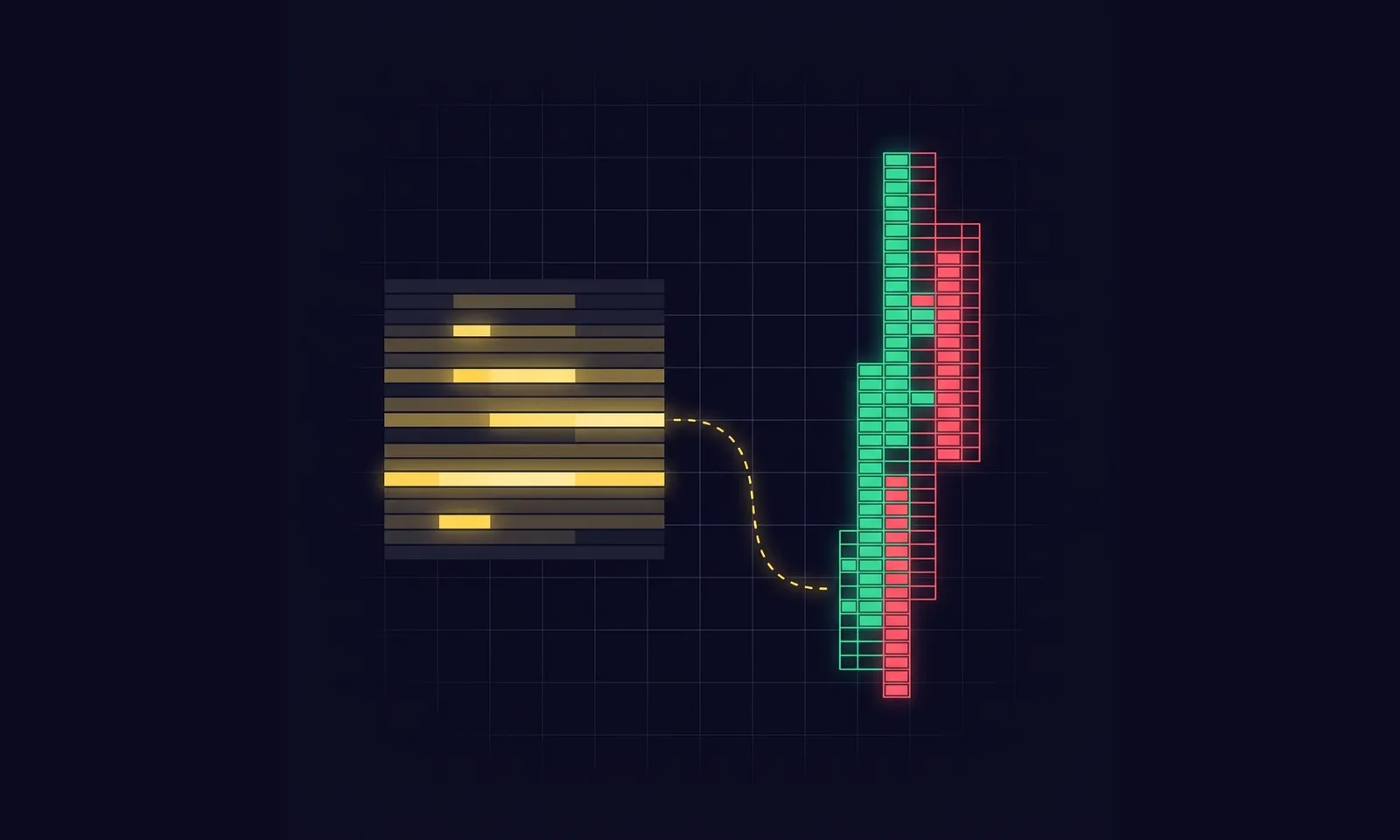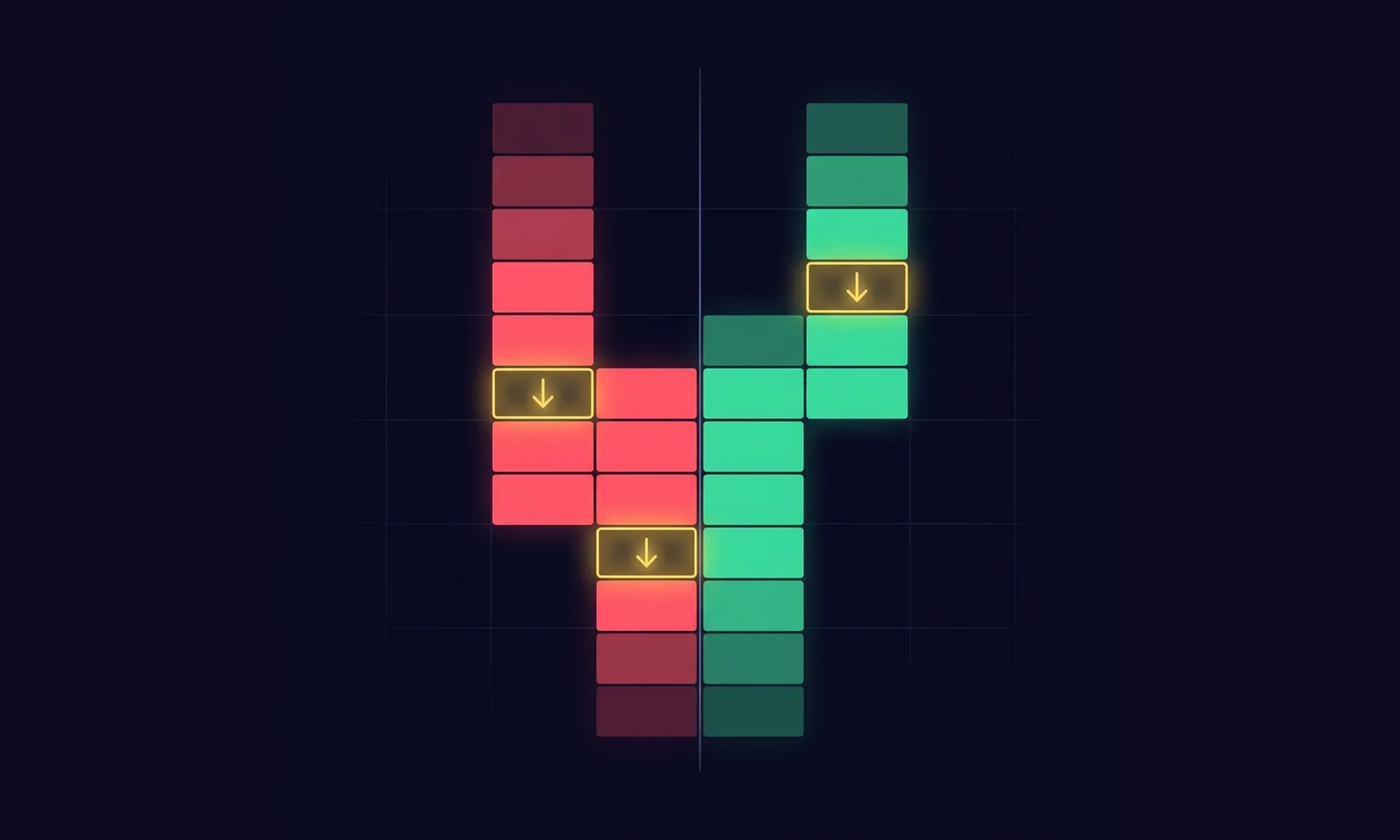
A pressure meter compresses two pieces of information into one gauge: aggressive trade delta (who is actually executing) and order-book depth imbalance (who is lining up with limit orders, and where). The result is fast, peripheral-vision context — who rules right now. Which is exactly why it is also the easiest tool to misuse: it looks like a traffic light, and it is not one.
Two components, two different qualities of information
- Executed delta = committed capital. What traded cannot be taken back. Hard information.
- Book imbalance = intent. Limit orders can be pulled at any moment — and spoofers actively exploit that (a giant "wall" lights up purely to manipulate perception and vanishes before the touch). Soft information.
So weigh the gauge with your head: when both components agree, you have a consistent story; when they diverge, that divergence is itself information (the book pushes, executions nowhere = probably theatre).
How to read it properly
- Move confirmation: price rises and pressure rises with it → the buyers' offensive is real, the trend has fuel.
- Divergence = exhaustion: price makes a new high, pressure fades → the dominant side is running out of breath. One of the strongest contextual warnings there is.
- Extreme pressure + flat price = absorption: the gauge screams aggression but price won't move → a strong passive player stands on the other side. Often precedes a reversal — seek confirmation in the footprint.
The most common mistakes
- Treating the gauge as an entry signal. It is reactive confirmation of what is happening, not a direction predictor. The entry belongs at a level (S/R, value area, VWAP); pressure merely confirms it.
- Ignoring absolute volume. A 90 % buyer dominance on five contracts is noise, not an institution.
- Reacting to every wiggle. What matters are massive, asymmetric pressures at structurally significant levels — not every twitch of the needle.
- Forgetting about smoothing. EMA smoothing cleans noise but adds lag — the smoother the curve, the later you see the change. And the whole point of order flow is immediacy.
- Trusting the book more than executions. The DOM component can be spoofed; the final word always belongs to what actually traded.
Style fit and what it brings
The pressure meter shines in scalping and day trading, where micro-timing decides: it is a peripheral dashboard that tells you the context is shifting without reading a single number. For swing trading it is thin on its own — there it belongs as a complement to the profile and VWAP.
An honest note: any summary gauge is compression by definition — it always loses detail. When the needle shows something interesting, verify it in the full data (footprint, book, delta) before you place an order.
Frequently asked questions
What two things does the pressure meter combine?
Aggressive trade delta (market-order buying versus selling) and order-book depth imbalance (resting bid size versus ask size). One shows action, the other shows intent.
Is the pressure meter a buy or sell signal?
No. It is a context gauge — it tells you who currently dominates, not where to enter. Pair it with levels, structure and the footprint for the actual trade.
Why is it smoothed with an EMA?
Raw pressure flips every tick and is unreadable. An EMA filters the noise so you see the prevailing balance instead of every flicker.
How is it different from CVD?
CVD is the cumulative history of aggressive delta; the pressure meter is the live, smoothed now, and it also folds in order-book imbalance. Use CVD for the story, the meter for the moment.
When is the pressure meter most useful?
At decision points: confirming a breakout has real aggression behind it, spotting when pressure fades into a level, or sizing down when the two sides are balanced.
The Order Flow Pressure Meter study in WyckFlow draws pressure as a corner HUD bar/gauge with configurable smoothing and weights for both components. Related reading: Bid/Ask Volume, CVD, Liquidity Heatmap.