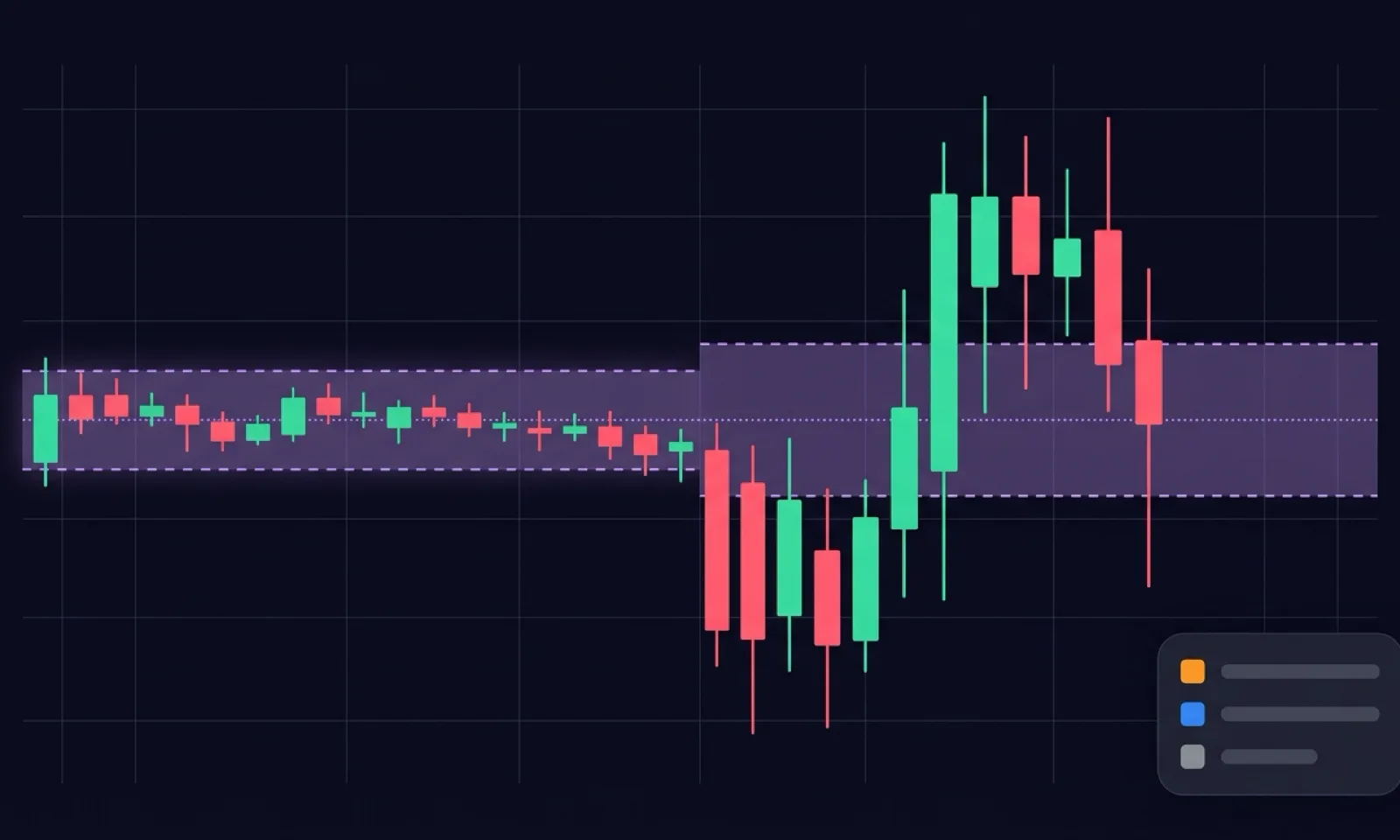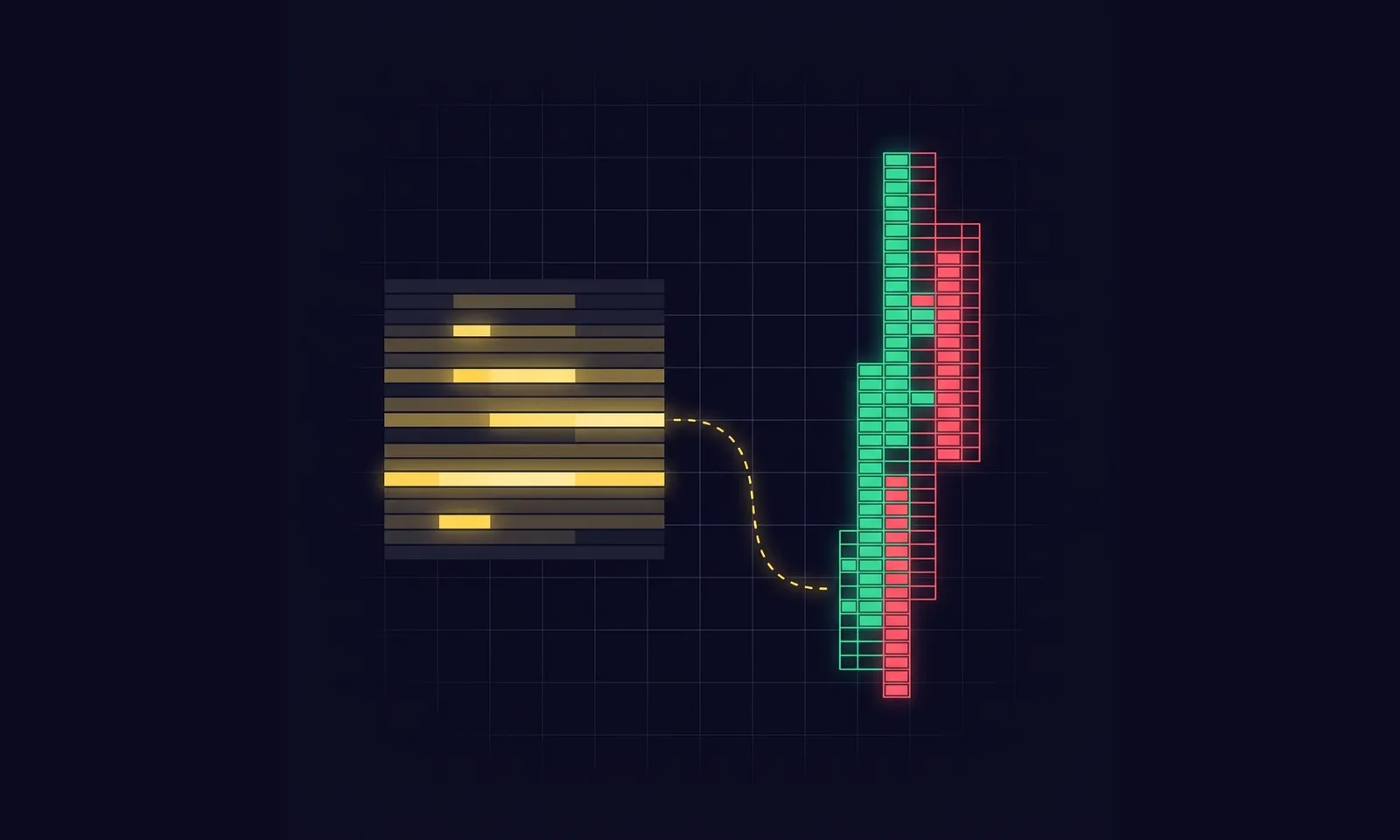
Institutional traders and large hedge funds do not trade like retail. When they need to accumulate or distribute large positions, they cannot simply click a button and hope for the best. Their massive orders inevitably leave distinct footprints in the order flow. Footprint (volumetric) charts are one of the most effective tools to detect this institutional presence in real-time.
This article covers three key footprint patterns that reliably reveal the presence of large players and shows you how to apply these insights practically in your day trading.
1. Stacked Imbalances
A buying or selling imbalance occurs when aggressive market orders on one side of the bid/ask spread heavily outweigh the passive limit orders on the opposing side. This ratio is measured diagonally (e.g., aggressive market buys at the Ask price versus aggressive market sells at the Bid price one tick below). The industry standard threshold is a 300% to 400% dominance.
Individual imbalances are common noise, but a concentrated effort by institutional players creates a Stacked Imbalance — when three or more consecutive price levels within a single bar exhibit an imbalance in the same direction.
- The Meaning: A stacked imbalance shows that a large buyer or seller is aggressively lifting offers or hitting bids across multiple ticks, showing strong conviction and a willingness to accept slippage.
- Trading Application: These stacked zones represent highly reliable support (for buying imbalances) or resistance (for selling imbalances). When price revisits these levels later, the institutional players often defend their entries, leading to high-probability bounces.
2. Oversized Imbalances
While regular imbalances filter for a standard ratio (e.g., 3:1), Oversized Imbalances target extreme discrepancies — typically ratios exceeding 1000% (a ten-fold dominance of one side) or areas where an unusually large absolute volume of contracts is executed at a single price point (Big Imbalances).
- The Meaning: These rare events highlight the exact price points where a large institution made a decisive tactical move. This could represent a hard defense of a support level or an aggressive breakthrough.
- Trading Application: If price approaches support and you see a massive sell volume print on the footprint, yet the candle fails to close lower and instead leaves a bullish tail (wick), aggressive sellers ran into a large passive buyer. This oversized imbalance level becomes a high-confidence anchor for your stop-loss.
3. Market Sweeps, Thin, and Zero Prints
When a large institution needs to execute a massive order immediately, they use a Market Sweep. This order sweeps through the depth of market (DOM), instantly consuming all available limit orders across multiple consecutive price levels.
This rapid execution leaves specific markers on the footprint chart:
Zero Prints: Price levels on the bid or ask side where 0 contracts were traded because price moved too fast for other participants to react.
Thin Prints: Price levels showing exceptionally low volume relative to the instrument's average.
The Meaning: Swept zones represent market inefficiencies (liquidity voids). Because the price moved so fast, proper two-way auctioning did not take place.
Trading Application: Markets have a strong tendency to return to these "empty" zones to complete the auction. Consequently, they serve as excellent targets (profit targets) for your trades. Conversely, when retested from the opposite side, they act as highly transitable zones where price can move rapidly without resting.
Practical Setup: Momentum Breakout and Retest
Here is how you can combine these three concepts into a unified trading plan:
- The Setup: Identify a key structural level (such as Yesterday's High or a Value Area boundary).
- The Breakout: Watch the price as it breaks through the level. You want to see the breakout supported by a buying Stacked Imbalance and strong positive delta. This confirms institutional backing rather than retail chasing.
- The Pullback: Avoid buying the breakout directly to protect yourself against false breakouts. Wait for a pullback to the upper boundary of the stacked imbalance zone.
- The Execution: Once the price tests the imbalance zone and shows signs of rejection (such as a delta flip to positive), enter long. Place your stop-loss just below the lowest level of the stacked imbalance.
Frequently Asked Questions
What is a stacked imbalance on a footprint chart?
A stacked imbalance occurs when 3 or more consecutive price levels in a single bar show a significant diagonal imbalance (usually 300% or more) in the same direction. It indicates strong, concentrated aggressive activity by large traders.
How do regular and oversized imbalances differ?
A regular imbalance identifies a standard volume imbalance (e.g., 3:1). An oversized imbalance looks for extreme conditions, such as a 10:1 ratio (1000%+) or exceptionally high absolute volume at a single tick, marking major institutional decisions.
What are zero prints and how are they used?
Zero prints are price levels where zero volume was traded on one side of the bid/ask during a rapid price move (market sweep). They represent a gap in the auction process, and the market often returns to fill them later.
Where should I place my stop-loss relative to stacked imbalances?
Since stacked imbalances are areas where institutions aggressively entered the market, these zones tend to act as support or resistance on a retest. Place your stop-loss just outside the far edge of the stacked imbalance zone.
Does institutional footprint reading work on all instruments?
It works best on centralized futures markets (like NQ, ES, CL) where the bid/ask tape is complete and unified. On decentralized markets like equities (with dark pools) or crypto (fragmented exchanges), the data is less reliable.
You can track stacked imbalances, oversized imbalances, and sweep signals in real-time using our Volume Imprint study for MotiveWave. It offers customizable filters and clear visual alerts on your chart. To analyze the overall balance of institutional pressure, we recommend combining it with the CVD indicator. Related reading: Footprint and Heatmap Synergy, Spoofing vs. Absorption on the Heatmap, Reading Big Trades, How to Read CVD, Footprint Imbalance & Absorption Guide.