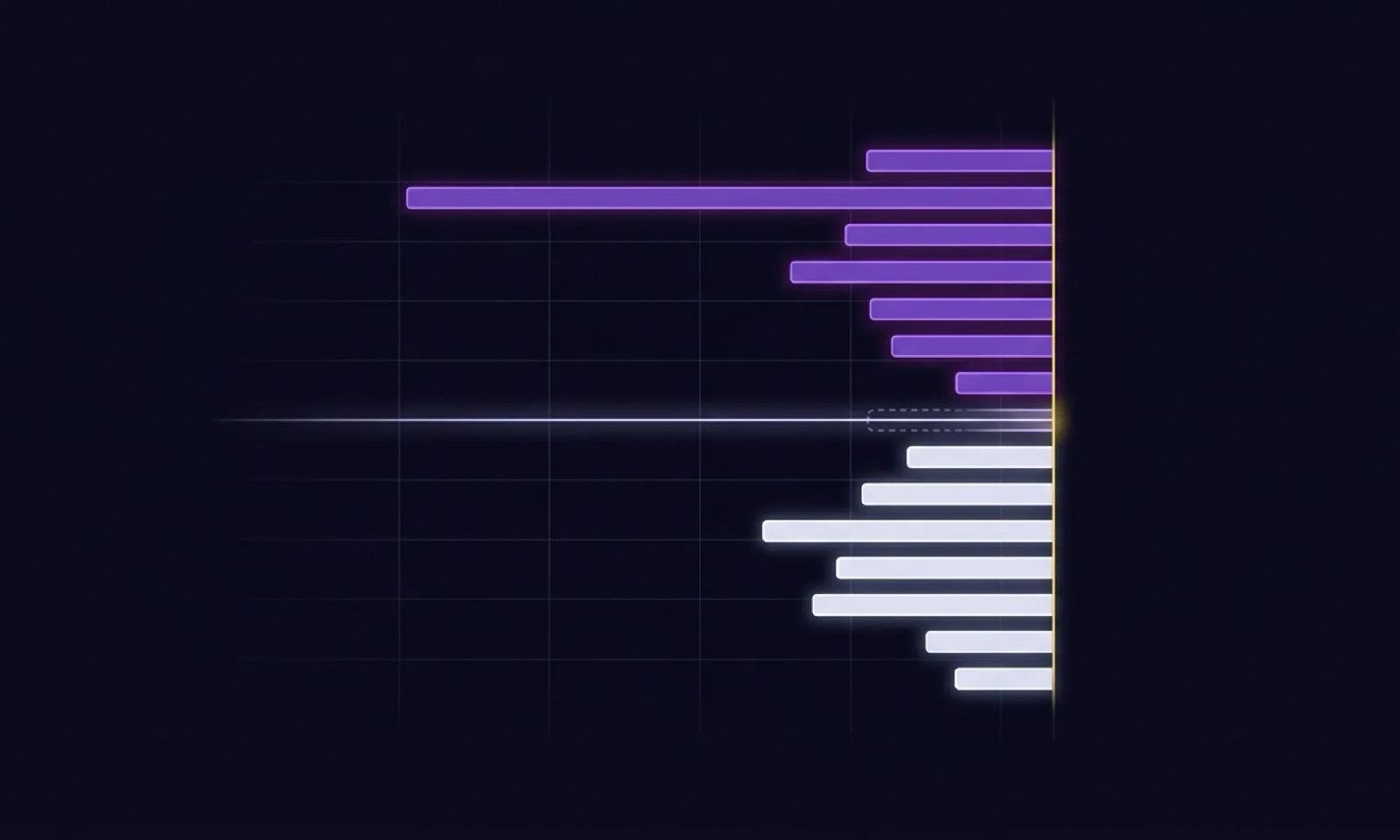
A standard candlestick chart only shows you the past — where trades have already occurred. To understand the future intentions of large traders, you must look into the Depth of Market (DOM) or order book. A liquidity heatmap serves as a time-lapse record of the DOM, visualizing where large institutions place their limit orders and how they adjust them over time.
One of the most critical skills when reading a heatmap is distinguishing between spoofing (fake orders designed to mislead the market) and real absorption (genuine buying or selling interest). This guide shows you how to differentiate these two states when the price interacts with key levels.
What Is Spoofing and How Does It Work?
Spoofing is a manipulative tactic where a large trader or algorithm places a massive limit order in the book (a liquidity wall) without the intention of letting it execute. The goal is to create a false impression of strong supply or demand to push the price in a desired direction.
- The Scenario: Imagine price is rising. An algorithm places a giant sell wall just above the market. Retail traders spot this wall, panic, and start selling their positions ahead of it. The algorithm successfully drives the price down, where it can then buy cheap.
- On the Heatmap: You see a bright, thick line of resting liquidity. However, as the price gets within a tick or two of this level, the line suddenly fades and disappears (a process called pulling).
- The Outcome: No large executed volume bubbles print at the level because the order was pulled. The price passes through this level with ease because there was no real commitment. This creates a liquidity void that can cause rapid price extensions and slippage.
What Is Absorption and Replenishing?
In contrast to spoofers, traders executing absorption actually want to buy or sell a large number of contracts. Since they do not want to scare the market by displaying their full size at once, they use Iceberg orders — displaying only a small fraction of their order and replenishing the size from the background as it gets filled.
- On the Heatmap: The bright zone of resting liquidity does not move or vanish as price approaches.
- Key Confirmation: As soon as the price touches the level, massive executed volume bubbles explode. You see aggressive market orders hitting the wall, but the price fails to move even a single tick. The passive wall is soaking up all the aggressive volume.
- The Outcome: Once the aggressors run out of contracts, the price reverses sharply away from the wall. This level becomes a highly reliable support or resistance zone.
Practical Trading Setups
Setup A: The Breakout Trap
Most retail traders buy breakouts of obvious resistance. Large players exploit this behavior:
- Watch a resistance wall on the heatmap. If the wall vanishes (pulling) just before the price touches it, retail sees a clear path and buys.
- However, no large green buy bubbles print on the breakout, showing a lack of institutional backing.
- Once price moves slightly higher, passive sellers place new large limit walls above the market and drive it back down with aggressive sales, trapping the breakout buyers.
- Trading Rule: Never buy a breakout if you see liquidity being pulled ahead of the price and there is no massive volume confirm.
Setup B: The Liquidity Sweep (Stop Run)
Large institutions target areas with high concentrations of retail stop-losses (typically just beyond swing highs and lows).
- Price spikes rapidly through a bright liquidity wall to trigger the stop-losses.
- Immediately after the breakout, aggressive activity and bubble sizes drop to near zero.
- Price quickly returns back inside the previous range.
- Trading Rule: Wait for the price to perform the sweep, and once it crosses back over the swept level, enter in the opposite direction (reversal). Place your stop-loss at the extreme of the sweep.
Trade Management Using the Heatmap
The heatmap is an invaluable tool for managing your open positions:
- Static Targets for Profit: If you are long and a solid, bright limit wall has been sitting 20 points higher on the heatmap for hours, this is your logical profit target. Price naturally travels between liquidity pools.
- Monitoring Defensive Shifts (Adding): If you are in a trade and see new, bright limit walls appearing against you on the heatmap, major players are setting up defenses. It is often wise to exit your position before the price hits the wall and reverses.
Frequently Asked Questions
How can I reliably tell spoofing apart from a real order?
The only reliable indicator is the order's behavior upon price contact. A fake order (spoofing) vanishes (pulling) just before touch with no volume executed. A real order (absorption) holds its ground, resulting in massive executed volume (large bubbles) without price progression.
What is replenishing?
Replenishing is typical for iceberg orders. A large participant continually refills limit orders at the same price level as soon as the active ones are filled. This keeps the level stable despite a massive influx of aggressive market orders.
Why does the price move toward bright zones on the heatmap?
Liquidity acts as a magnet. Large participants need counter-liquidity to fill their size. The market naturally searches for areas with a high density of limit orders to match supply with demand efficiently.
What should I do if a limit wall on resistance suddenly disappears?
This indicates either spoofing or pulling (sellers retreating). In both cases, a liquidity void is created above the market. If you are short, this is a warning sign to exit, as price can shoot up rapidly due to the lack of resistance.
Are iceberg orders visible on the heatmap?
The heatmap only displays the visible portion of the limit order. However, if an iceberg is active, you will observe a thin line holding its ground despite massive volume bubbles printing. To detect icebergs systematically, use a dedicated Iceberg Detector.
You can monitor resting limit orders and wall behaviors in real-time using our Liquidity Heatmap study for MotiveWave, which records and plots the historical order book. To detect hidden refreshed orders, we recommend combining it with our Iceberg Detector tool. Related reading: Footprint and Heatmap Synergy, How to Spot Institutional Activity on Footprint Charts, Liquidity Heatmap & Walls, Iceberg Orders Detection Guide.