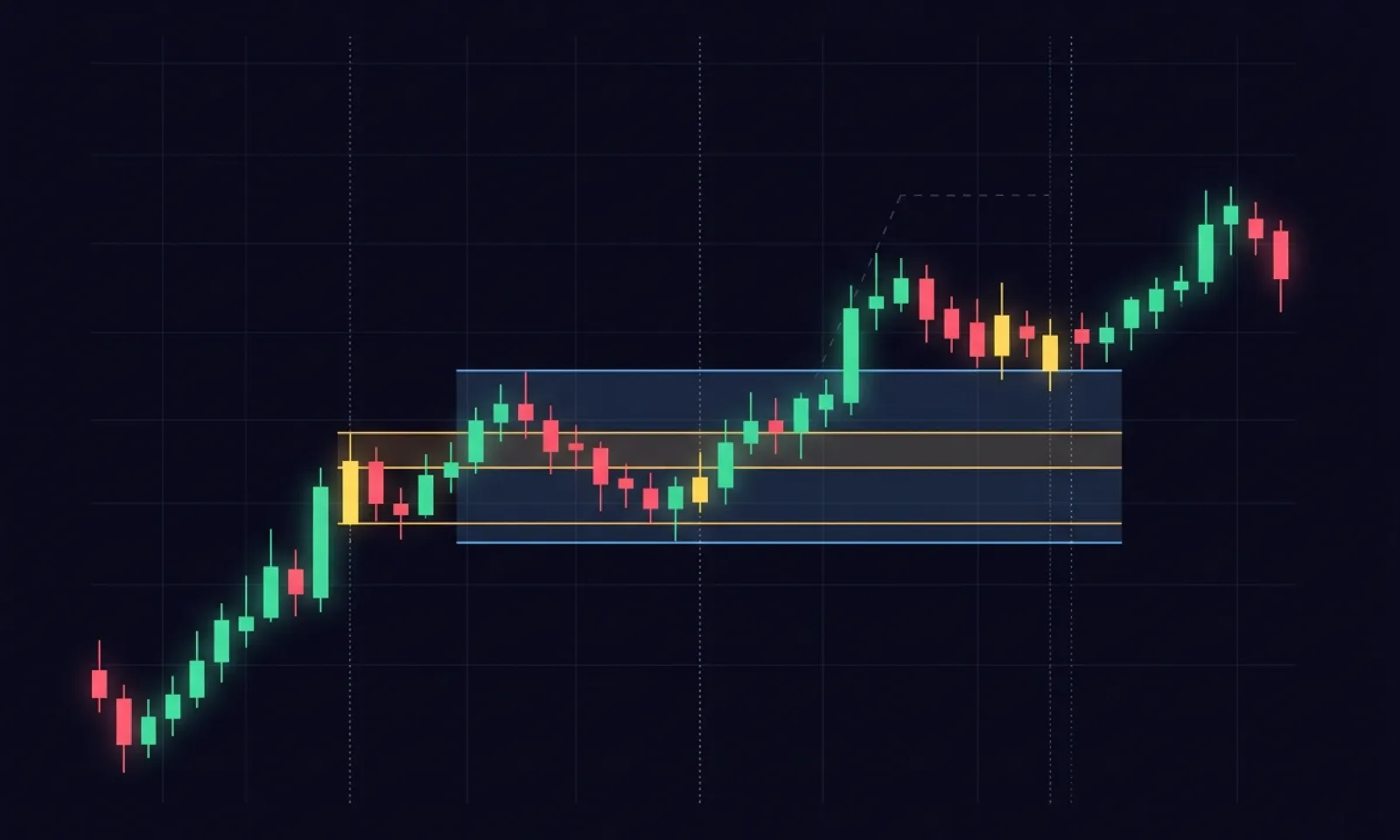
A volume profile turns volume sideways: instead of "when", it shows at which prices trading happened. The result is a map of which prices the market accepted (built volume) and which it merely flew through. And volume is the one piece of information that cannot be manipulated — which is why the profile is such a valuable foundation for objective market reading.
The one-minute glossary
- POC (Point of Control): the single price with the most traded volume — the most liquid spot of the profile.
- Value Area (VA): the region around the POC containing 70 % of all volume; its edges are the VAH (top) and VAL (bottom).
- HVN (High Volume Node): a range with heavy volume — always a potentially strong S/R zone.
- LVN (Low Volume Node): a spot the market flew through quickly — an anomaly it tends to come back and "repair".
The key concepts: acceptance × rejection
- Acceptance: the market breaks a level and builds volume above it at lightning speed (easily as much in 15 minutes as in the previous 8 hours) → prices are confirmed by both sides; the market hunts for new value. You do not trade against fresh acceptance — a short at resistance above a huge acceptance is technically wrong even when it happens to work.
- Rejection / vanishing volume: the market falls toward a level in a one-way auction but volume progressively disappears → there is no interaction, the move is hollow and very likely to snap back into value (often helped along by bigger players' icebergs).
- Fresh vs old LVN: today's post-breakout LVN = the spot to position with the trend. Yesterday's unfilled LVN = the main magnet of the day — the market goes to fill it surprisingly reliably (rule of thumb: ~7 times out of 10). Always mark unfilled anomalies.
- Lost volumes (the "A-setup"): the value area shifts lower, the market rejects the lower prices, holds them in a rotation, then launches back in a one-way auction to test the original volumes — which then act as an extremely strong resistance/support for an entry.
Rules by phase of the day
- Balance (D-profile): you don't trade breakouts, you trade returns into the Value Area after false excursions. Take profits quickly at the opposite swing — letting a trade "breathe" inside a rotation means giving it back.
- Trend (P/b-profile): position in fresh LVNs behind breakout candles; once new extremes stop building volume and the profile fattens into a D, with-trend entries lose their edge.
- Session handoff: beware Europe → America. The US session brings multiples of the capital and routinely destroys the European trend — protect European-session profits before the US open.
The most common mistakes
- Blindly trading VAH/VAL/POC. They are computed lines — without price-action context and interaction at the level they mean nothing.
- Shorting into acceptance (or buying against it) — the most expensive technical error in profile trading.
- Switching off market structure. An impulse through the whole VA is a warning, not an invitation to fade immediately.
- Gambling with the exit. In balance you take profit at the opposite edge — hoping for the breakout means surrendering your edge.
- Subjectivity. "It's been falling so long, it has to turn" is not analysis. The profile exists to replace that with facts.
Style fit and what it brings
The profile is the backbone of day trading (the developing daily profile through Asia → Europe → US) and, being fractal, works identically on weekly and monthly profiles for swing. It doesn't produce signals — it produces the map: where value is, where the anomalies are, where a trade is worth hunting and where it is technically forbidden.
Frequently asked questions
What is the POC?
The Point of Control: the price with the most traded volume in the profile. It acts as a magnet and a pivot — price often returns to it and reacts there.
What is the Value Area?
The price band holding about 70% of the profile's volume, centred on the POC — the range the market accepted as fair. Its edges (VAH and VAL) are common reaction levels.
What are low-volume nodes?
Thin parts of the profile where little traded — price moved through fast. They offer little support or resistance, so price tends to travel quickly through them again.
Fixed-range or session profile — which?
A session profile resets each day; an anchored fixed-range profile measures a move you pick (a swing, a news spike). Use anchored when you want the profile of a specific event, not the calendar.
Why use real traded volume, not tick count?
Tick-count "volume" counts trades, not contracts, so it distorts the profile. A profile from actual traded volume (ideally with a bid/ask split) reflects where money really changed hands.
The Anchored Volume Profile study in WyckFlow computes the profile from real tick data over any range you select with two anchors — POC, 70% VA, bid/ask split and a live developing profile. Related reading: Footprint, CVD, Big Trades.