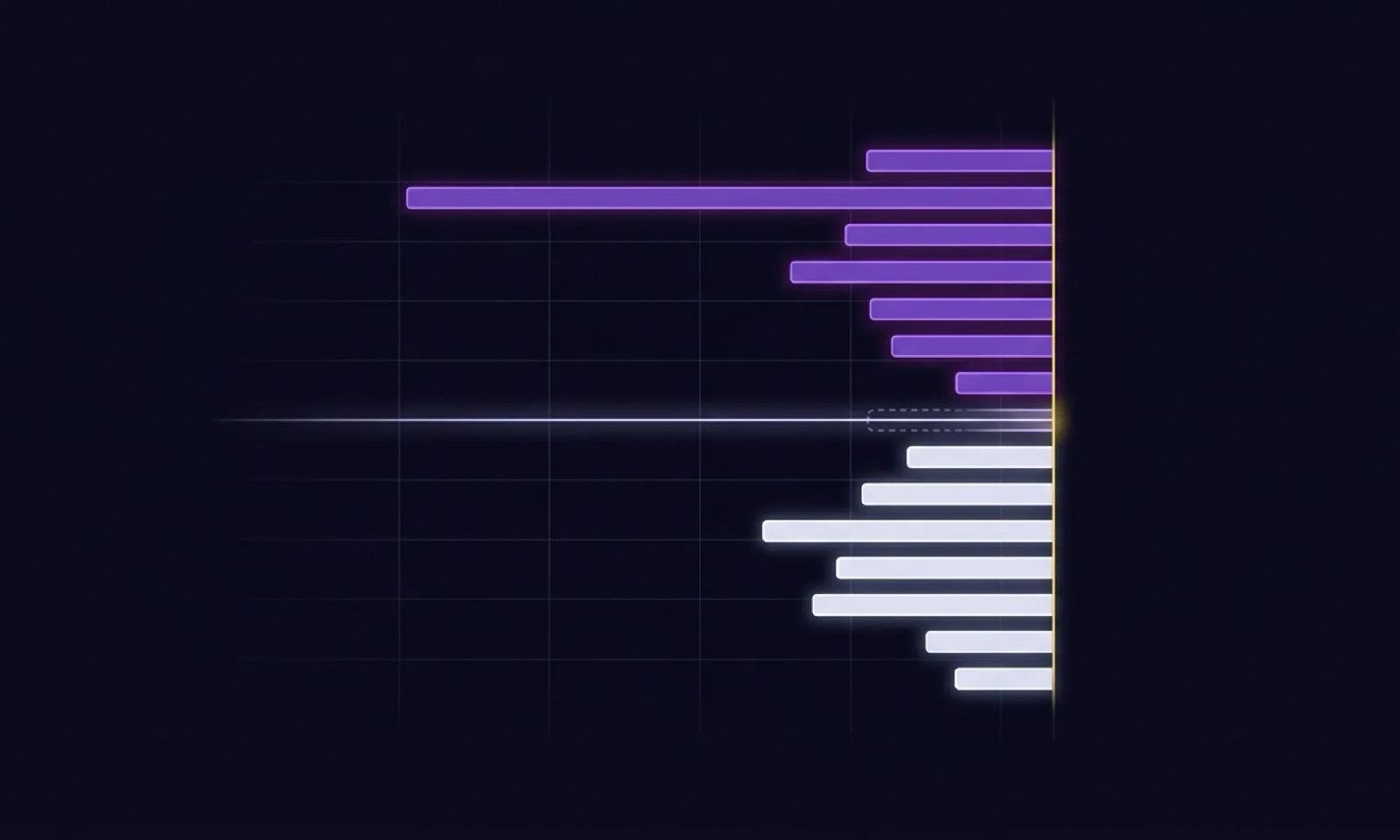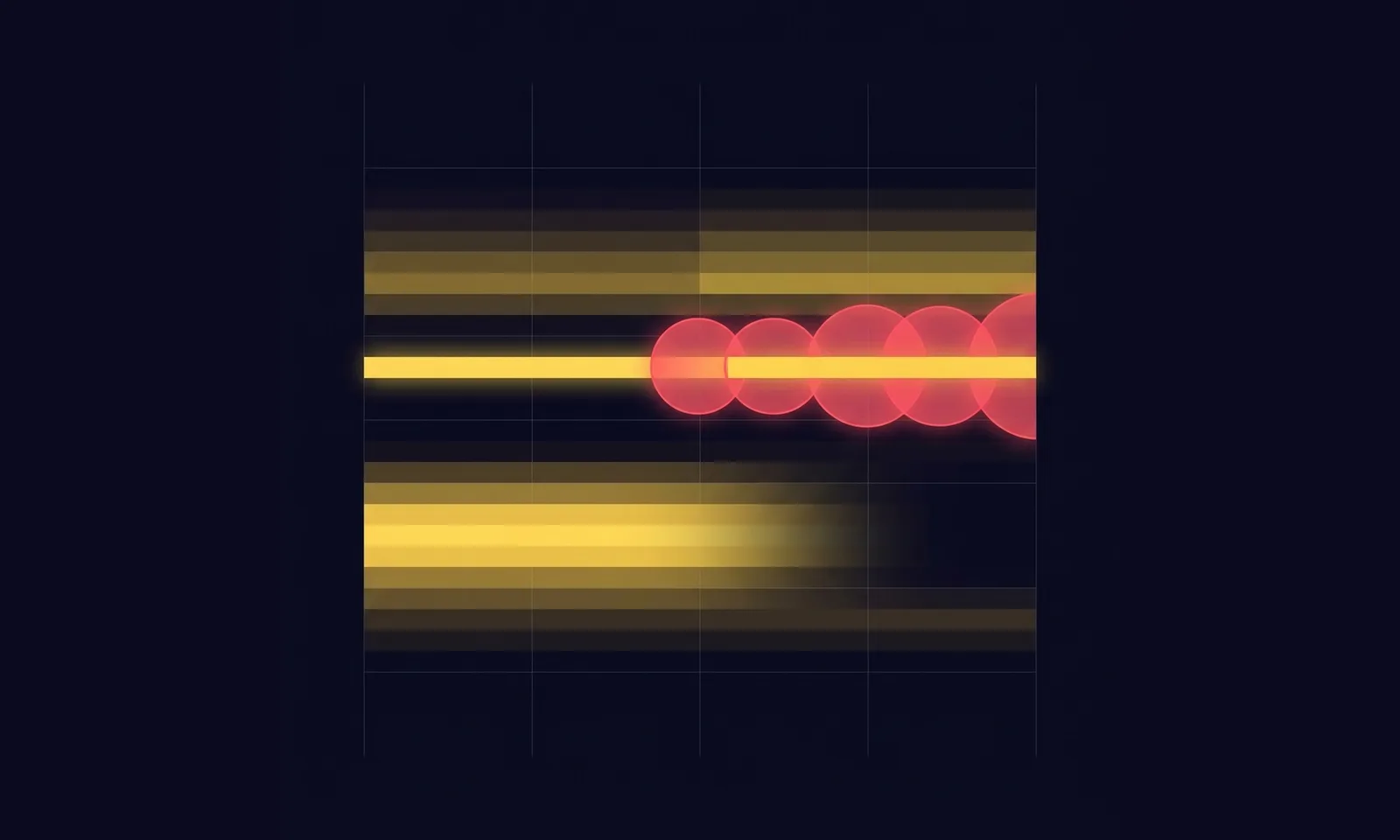
An iceberg is a large limit order that deliberately shows only a small visible tranche — as soon as it fills, the next slice instantly replaces it. That's how institutions accumulate or distribute without spooking the market. For you it is one of the most valuable footprints there is: a level that someone big is actively defending with hidden capital.
The classic signature: executed ≫ visible
- The book shows, say, 6 contracts at a level, but the tape prints 8, 20, 50… at that price — the surplus proves hidden liquidity was hit.
- Second signature: a constant visible size while dozens of trades stream through the level — it refreshes after every fill.
- A buy iceberg = hidden support: aggressive selling hammers it and price won't fall. A sell iceberg = hidden resistance: a buying frenzy stops dead against a wall nobody can see.
Detection limits — honestly
- Exchanges do not label icebergs. From aggregated MBP data (regular Level 2 — per-price totals) they are detected only indirectly: the underflow test (more executed than was visible) and instant refilling. It is a heuristic — false positives exist.
- Synthetic icebergs managed by software outside the exchange (each tranche = a brand-new order with a new ID) cannot be reliably seen even in full MBO data; HFT algorithms can also imitate iceberg-like behaviour.
- Don't confuse it with spoofing: spoofing is visible liquidity that vanishes before execution. An iceberg is confirmed by executions on the tape, not by colour in the book.
When an iceberg "fails" — and what that means
An iceberg guarantees no reversal. If the aggression is too strong, the hidden reserve exhausts and the barrier breaks — and because many traders leaned on that level, the follow-through move tends to be 2–3× larger than average (a stop cascade). Hence the iron rule: the moment the defended level falls, the trade hypothesis is dead — get out immediately.
How to trade with an iceberg
- Always with it, never blindly against it. Standing in an iceberg's way is stepping in front of a moving train. And don't try to front-run it by a tick either — the institution can cancel at any moment and your "support" evaporates.
- Enter only once the iceberg has proven its defence (the level holds + delta starts turning), in the iceberg's direction.
- Stop loss tight behind the defended level (about 1 tick behind the iceberg) — if it falls, there is nothing to discuss.
- Target at least 2R; a time-stop too: if it hasn't moved a few ticks your way within ~5 minutes, momentum is dead — close.
- Confluence is mandatory: CVD divergence + confirmed absorption on the tape + the detection itself. And trade liquid hours (for US indices typically 9:30–11:00 and 14:00–15:15 ET) — in a thin market the heuristic gets noisy.
Style fit and what it brings
Iceberg detection is a scalping and day trading tool on centralized futures (NQ, ES, CL) where full depth is available. It gives you a head start of seconds to tens of seconds before the hidden defence shows up in price — and above all an objective answer to "who is really standing here".
Frequently asked questions
What is an iceberg order?
A large limit order that displays only a small slice at a time and automatically refills as it is hit — so its real size stays hidden from the order book.
How can you detect one without per-order data?
As a heuristic: at one price, executed volume far exceeds the visible resting size, the same side keeps aggressing, and the level caps the bar and rejects price. That "executed much greater than visible" underflow is the core tell.
Are iceberg flags ever wrong?
Yes — with aggregated depth it is an inference, not a certainty. Treat a flag as "a big passive player is likely here" and confirm with absorption and the price reaction.
Iceberg versus a heatmap wall — what is the difference?
A heatmap wall is visible resting size; an iceberg is hidden size revealed only by the executions through it — often invisible on the heatmap until it trades.
How do I trade around an iceberg?
Do not fight it: a refilling iceberg absorbing aggression at a level is a reversal candidate in its favour. Wait for the level to hold and the aggressor to give up, then trade with the iceberg.
The Iceberg Detector study in WyckFlow runs exactly this underflow test (executed ÷ visible volume) with aggressor-dominance and extreme-absorption filters — and honestly declares itself a heuristic built on MBP data. Related reading: Liquidity Heatmap, Big Trades.