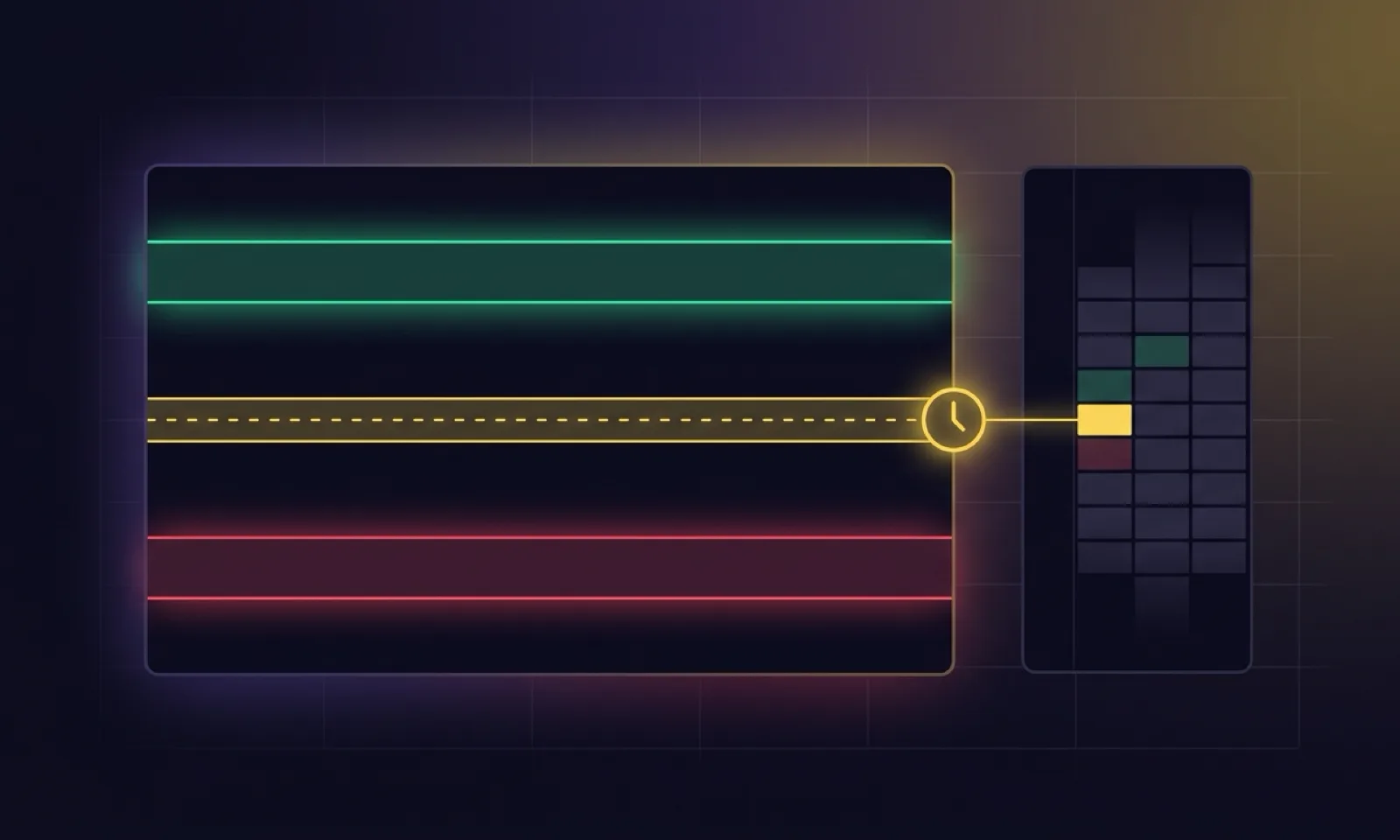
During monthly options expiration (OPEX) week, trading often occurs under mechanical compression. Price can slow near concentrated strikes as dealers hedge delta in underlying futures. Ahead of expiration on Friday, 16 October 2026, expiring gamma helps read whether levels hold as magnets or break under aggressive flow.
GEX provides the structural map; pair it with real-time execution tools: footprint, bar delta, and cumulative delta.
What expiring dealer gamma means on the tape
Dealers hedge option books by trading the underlying market (delta hedging) to neutralize directional risk. Summed across the market, this aggregate mechanical flow is what Gamma Exposure (GEX) measures.
The study maps where hedging clusters: Call and Put walls above and below price, Max Pain, and Absolute Gamma.
On equity and index markets, monthly expiration falls on the third Friday of the month (Friday, 16 October 2026). As open interest updates daily, levels redraw and often migrate to meet price.
Pinning, magnets, and regime boundaries
The relationship between price and the Gamma Flip establishes the market regime:
| Level | Role | Expected tape behavior |
|---|---|---|
| Gamma Flip | Boundary between regimes | Dampening above; acceleration below. |
| Call Wall | Largest positive gamma above price | Positive gamma concentration; observe participant reaction. |
| Put Wall | Most negative gamma below price | Negative gamma concentration; breaks can accelerate flow. |
| Max Pain | Strike where most options expire worthless | Afternoon gravity point on expiry day in positive gamma. |
| Absolute Gamma | Largest total gamma concentration | Primary magnet and strongest pin. |
Max Pain matters primarily on expiry days (monthly OPEX Fridays, and daily for indices). On Friday afternoon near Max Pain in positive gamma, it acts as a gravity point where price compresses into the close rather than breaking out, though aggressive order flow can still overrun the strike.
Absolute Gamma acts as the day's primary magnet. If a primary wall breaks, attention often shifts to secondary walls or Absolute Gamma; confirm with order flow.
0DTE dynamics vs cumulative GEX: when clocks disagree
On index products (NDX and SPX), options expire daily, packing immense gamma into each session:
- Cumulative GEX maps multi-day structure from monthly and weekly open interest.
- 0DTE GEX reveals immediate intraday pressure driving session swings.
- Disagreement warns of acceleration: When cumulative GEX is positive but 0DTE is sharply negative, divergence warns of late-day acceleration into the close.
Second-order greeks add context. Charm (CHEX) measures hedging changes from passing time; for 0DTE around 1:00–2:00 PM NY, negative Net CHEX implies dealer buying, while positive Net CHEX implies dealer selling into the close. Vanna (VEX) measures hedging shifts when implied volatility moves. Treat both as context, not certainty.
The order flow test: confirming or rejecting the pin
GEX provides structural context; order flow provides timing. As detailed in How to Read GEX and GEX Meets Order Flow, never trade a gamma line blindly.
At a key OPEX strike, evaluate four questions:
- Is aggression arriving? Check for diagonal imbalances or bar delta approaching the level.
- Is someone absorbing? Look for absorption: heavy volume at the extreme, failing diagonal aggressors, and rejection wicks (footprint guide).
- Does CVD agree? Verify whether CVD confirms or diverges.
- Is resting liquidity real? Observe whether heatmap walls refill or pull.
A defended wall displays absorption, stalling CVD, and a delta reversal on the rejection candle. An overrun wall shows stacked imbalances sweeping through, new CVD extremes, and resting orders pulling.
After expiration: why yesterday's levels may no longer apply
Levels are calculated from open interest, which updates once per morning in the US session.
After expirations and large moves, open interest reshuffles completely and levels are redrawn. Yesterday's levels may no longer apply. Always read current session levels on the free daily gamma levels page.
A checklist for OPEX week
- Check regime: Positive gamma (above Flip) dampens moves; negative gamma (below Flip) amplifies them.
- Mark key levels: Note Call Wall, Put Wall, Max Pain, and Absolute Gamma.
- Compare cumulative and 0DTE GEX: Regime divergence warns of late-day trend acceleration.
- Note Charm drift: Observe afternoon time-decay bias into the close.
- Wait for interaction: Require confirmation from footprint imbalances, bar delta, or CVD at the strike.
- Regime volatility: Ranges and swings expand in negative gamma compared to positive gamma.
An honest risk note: Dealer hedging describes mechanical pressure, not guarantees. News shocks, aggressive order flow, and expiration flows can overrun any strike. Position size and risk management are always the reader's responsibility.
Frequently asked questions
What happens to dealer gamma during OPEX week?
Open interest concentrates heavily in monthly contracts. Dealers delta-hedge books in the underlying market, which GEX measures. After expiration, open interest reshuffles and levels are redrawn, often migrating to meet price.
Is Max Pain guaranteed to pin price on Friday?
No. Max Pain marks where the most options expire worthless, providing context rather than certainty. While price can gravitate toward concentrated strikes in positive gamma, aggressive order flow, news shocks, or dominant 0DTE flows can overrun the strike without pinning.
How does order flow confirm if an OPEX wall is holding?
A holding wall shows absorption: heavy volume at the extreme price with no progress, diverging CVD, and a delta reversal on the rejection candle. If CVD prints new extremes and imbalances stack through the strike, the wall is giving way.
What does disagreement between 0DTE and cumulative GEX indicate?
Cumulative GEX reflects broader positioning; 0DTE reflects immediate intraday contracts. When cumulative gamma is positive but 0DTE gamma is sharply negative, intraday selling can overpower the calm regime, warning of late-afternoon acceleration.
Can I use pre-expiry GEX levels the following Monday?
No. Open interest updates once per morning in the US. After expirations and large moves, open interest reshuffles completely and levels are redrawn. Yesterday's levels may no longer apply; always read current session levels.
You can track the Gamma Flip, Call Wall, Put Wall, Max Pain, Absolute Gamma, secondary walls, 0DTE view, Vanna/Charm drift, and monthly OPEX countdown in MotiveWave using the Gamma Exposure (GEX) study ($13/mo standalone, included in Pro & Elite bundles; 14-day free trial of everything, no credit card). Pair it with free CVD and paid Volume Imprint ($17/mo). Related reading: How to Read GEX, GEX Meets Order Flow, Free Daily Gamma Levels.