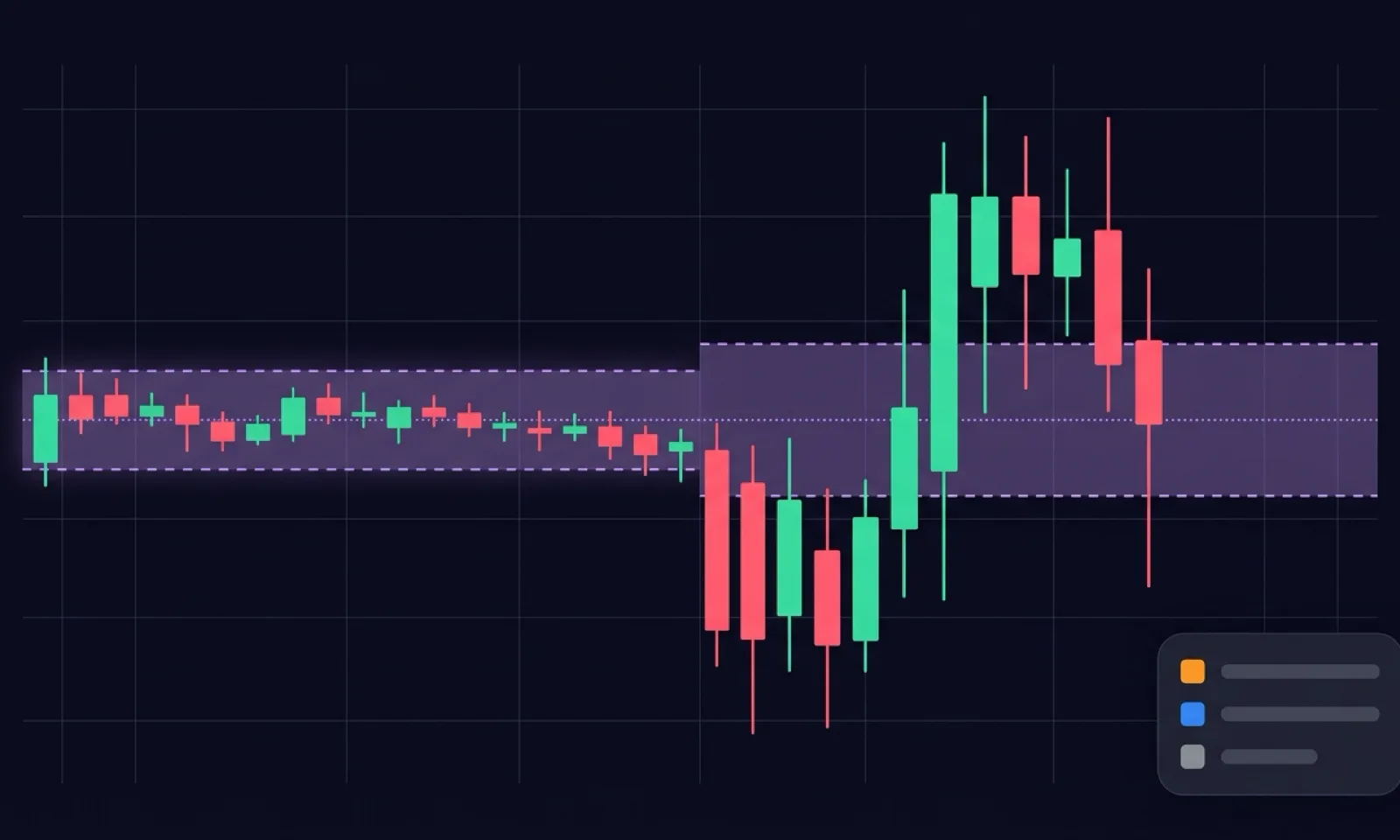
WyckFlow Vol Regime
A direction-agnostic volatility-regime HUD — WHETHER and HOW BIG, never WHICH WAY
WyckFlow Vol Regime combines three independently validated layers: an intraday regime classifier (compression vs. expansion from the ratio of recent to baseline bar range), a scale-free forward-range forecast (square-root-of-time scaling), and a morning day-activity badge (the first N minutes' volume against the same weekday's median). All three feed a visual expected-reach envelope drawn around price from the session open. The study's own author is upfront that an exhaustive search for a directional edge on this project's data failed — the one signal that survived out-of-sample testing was volatility persistence, and that's exactly what Vol Regime puts on the chart.
Standalone subscription for a single study. Cancel anytime.
Cheaper in a bundle →What it does
- EXPANSION/QUIET/NORMAL regime classifier from the bar-range ratio (validated Spearman +0.42 OOS)
- Forward-range forecast (square-root-of-time scaling, a global constant)
- Day-activity badge — this morning's volume against the same weekday's median (validated r≈0.47)
- Expected-reach envelope from the session open, optionally scaled by the day badge
- Corner HUD with sizing guidance (wider/tighter stops)
- Auto-hides on Daily+ timeframes
How to read it
EXPANSION = wider stops and targets, expect noise — never read it as a direction signal.
QUIET = smaller targets, expect chop; mean reversion has better odds, big breakouts tend to be fake.
Day badge ACTIVE + intraday EXPANSION together = the strongest context for a big move today.
The expected-reach envelope is a span statistic for sizing, not a target or entry level — it's routinely touched or exceeded.
Compression does not predict breakout direction — the validated effect is persistence, not squeeze-timing.